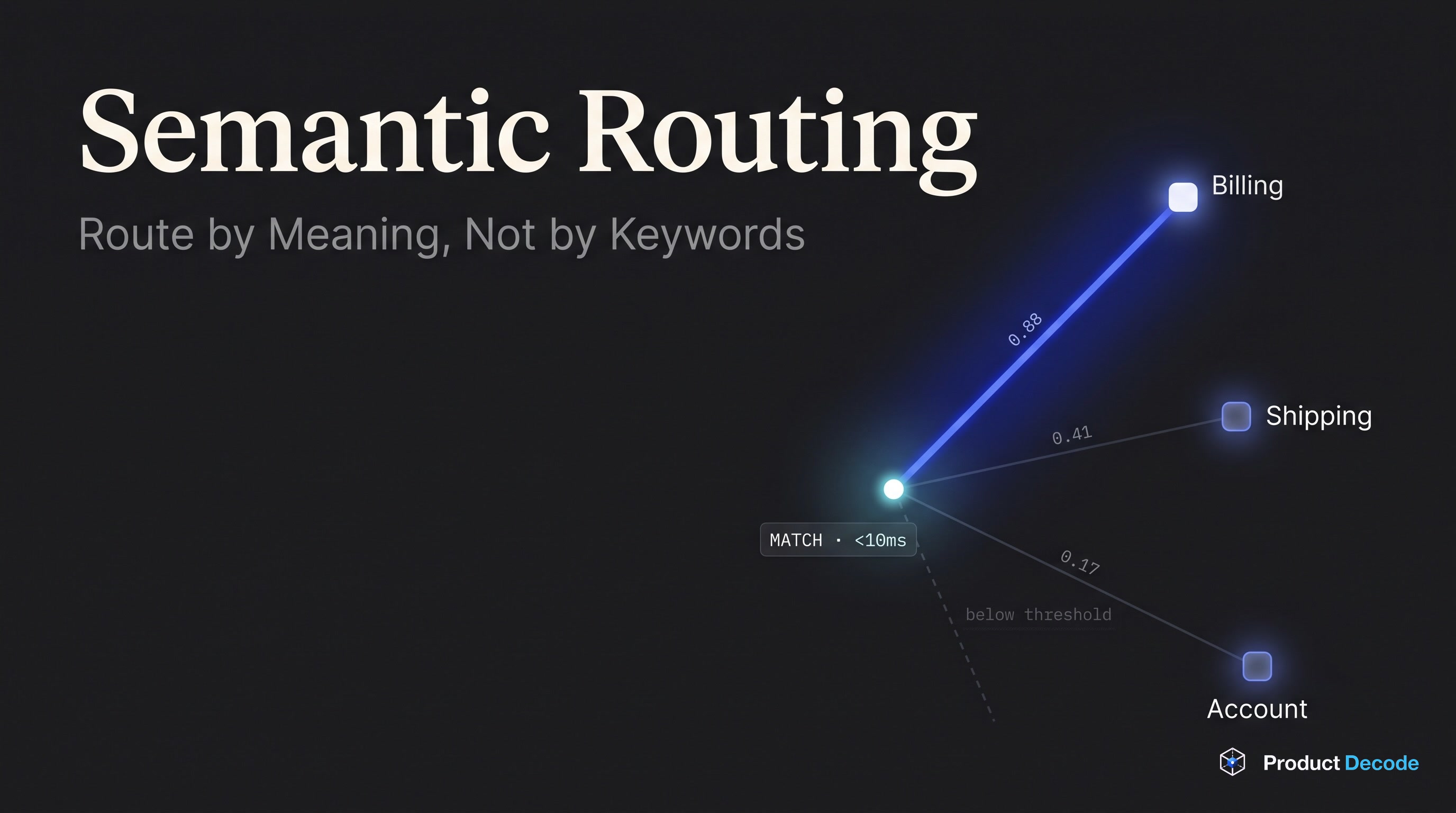
Semantic Routing: Intent-Based LLM Dispatch Without Keywords
By comparing vector distances instead of running inference, semantic routing classifies user intent in milliseconds at near-zero cost. But embedding geometry remains fundamentally blind to reasoning difficulty.
Part of: Smart Model Routing: How to Cut LLM Costs Without Sacrificing Quality
In the first two installments of our model routing series, we dissected two fundamentally contrasting approaches: Model Cascading relies on retrospective trial-and-error (execute on a cheap model first, verify against automated tests, escalate on failure), while the Classifier-based Router adopts upfront cognitive triage (a lightweight model reads the prompt and emits a structured routing verdict).
Both architectures share a common characteristic: they depend on a generative language model to reason, evaluate, or generate tokens at the gateway.
Semantic Routing changes the paradigm entirely: it eliminates LLM inference at the routing boundary. Rather than prompting a model to deliberate over prompt complexity, semantic routing maps text into mathematical coordinates (vector embeddings) and evaluates geometric proximity across a high-dimensional space. The entire triage operation completes in 5 to 10 milliseconds at virtually zero token expense.
Yet high-dimensional geometry carries subtle, fatal blindspots. Without a rigorous understanding of its mathematical boundaries, a semantic router will dispatch catastrophic mistakes with complete mathematical confidence.
How It Actually Works: Geometry, Not "Reasoning"
Marketing literature often anthropomorphizes semantic routing as an "intelligent agent that intuitively comprehends user intent." In production engineering, there is no intelligence "thinking" or "reading" behind the scenes.
Semantic routing is pure, unadulterated geometric nearest-neighbor calculation:
- Predefined Route Catalog: You establish the discrete business domains of your application (e.g.,
billing,shipping,account_security). For each route, you supply 5 to 20 representative exemplar utterances. - Precomputed Centroid Vectors: An embedding model (such as OpenAI's
text-embedding-3-smallor an open-weight model likebge-small) transforms each exemplar into a dense 1,536-dimensional vector. The system calculates the mathematical mean across these vectors to produce a single representative centroid anchored in vector space. - Inference-Free Vector Matching: When an incoming user request arrives, the router executes two sub-millisecond steps:
- Encodes the user prompt into a single embedding vector (consuming roughly 50–150 input tokens, producing zero output tokens).
- Computes the dot product (Cosine Similarity) between the query vector and precomputed route centroids in memory.
- Assigns the query to the nearest centroid ($k=1$ nearest-neighbor).
Because the matching step consists of elementary matrix operations in RAM, vector evaluation takes less than one millisecond. The entire roundtrip—including network latency to the embedding API—resolves in 6 to 10 milliseconds at approximately $0.00002 per call. That is roughly 20x cheaper and 15x faster than invoking a lightweight classifier LLM.
Why It Excels at Intent Recognition, but Remains Blind to Difficulty
Semantic routing's primary strength is identifying topical intent across divergent phrasing without brittle keyword dictionaries.
Consider the classic example from our pillar guide: "Why was I billed twice?" and "My credit card statement has a duplicate charge from yesterday" share zero common vocabulary. Yet in high-dimensional embedding space, models trained on vast corpora recognize their deep conceptual equivalence. Both query vectors project directly into the billing cluster.
However, this exact geometric property introduces an architectural paradox:
Paraphrases of the same intent cluster tightly together in vector space, but computational complexity and reasoning difficulty do not form distinct geometric clusters.
Consider two contrasting queries:
- Request A: "What was the total dollar amount on my August invoice?"
- Request B: "Reconcile these 14 international billing addendums, resolve withholding tax discrepancies under Vietnamese tax code, and draft a formal dispute resolution..."
Both queries are undeniably "about billing." In vector space, both Request A and Request B exhibit cosine similarities exceeding 0.86 against the billing centroid.
The semantic router will happily assign both queries to the exact same route. But in terms of system execution:
- Request A requires a single-line database lookup or a tiny $0.0005 model executing in 200ms.
- Request B requires a flagship frontier reasoning model ($0.0300) executing multi-document synthesis over 3,000ms.
If you rely solely on semantic routing to select model tiers, your architecture will fail continuously: it will either under-route Request B to a small model that hallucinates complex tax law, or over-route Request A to a frontier model, wasting 97% of your inference margin.
This illustrates the crucial engineering boundary: Semantic Routing and Classifier Routers are not rivals—they are complementary halves of an optimal triage engine. Semantic routing answers "What domain is this query about?" (Intent), while a Classifier Router answers "How much cognitive power does it require?" (Reasoning Difficulty).
Vector Space: Geometric Distance & The Difficulty Blindspot
Simulate Cosine Similarity matching in high-dimensional embedding space. Discover why semantic routing is lightning-fast at intent recognition, but entirely blind to computational difficulty.
"Why was I charged twice for my subscription this month?"
↳ Keywords ask about subscription billing. Embedding vector lands directly adjacent to the Billing centroid with 0.91 similarity.
The Hidden Operational Cost: Route Catalogs & Embedding Drift
Under Model Cascading and Classifier-based Routing, the system does not require you to enumerate every business topic your users might ever discuss. They simply evaluate programmatic assertions or assign broad difficulty tiers (small, medium, powerful).
Semantic routing inverts this flexibility: it strictly requires an explicitly curated catalog of known route centroids.
In production, this catalog is never static:
- When your company launches a new product feature (e.g., instant wallet cashbacks), a flood of novel user inquiries appears.
- If engineers do not proactively curate sample utterances and generate new centroid coordinates, these inquiries become architectural orphans.
- User vocabulary naturally shifts over time (slang, emerging product codes, seasonal phrasing), causing vector projections to drift away from original cluster centers.
The primary cost of semantic routing is rarely visible on monthly API invoices. It lives in Operational Overhead (Ops Effort): monitoring cluster boundaries, clustering unassigned queries to discover emerging topics, and continuously rebalancing centroid coordinates.
The Signature Failure Mode: The Nearest-Neighbor Trap
In vector mathematics, nearest-neighbor search ($k=1$) suffers from an inherent flaw: it is mathematically incapable of admitting ignorance. It always returns a winner.
If a user submits a classical poem, a malicious jailbreak prompt, or an out-of-distribution question about astrophysics into your e-commerce customer support chatbot:
- The system computes cosine distance against your three provisioned centroids:
billing,shipping, andaccount_security. - Even if the closest cluster is
shippingwith an abysmal similarity score of 0.38, standard nearest-neighbor algorithms will proudly declare: "Route match: Shipping!" - The poem is unceremoniously routed to an automated tracking number pipeline.
The algorithm has zero conceptual awareness that it is extrapolating across empty semantic space.
The Mandatory Defense: Calibrated Cosine Threshold Cutoffs
To neutralize the nearest-neighbor trap, production semantic routers must enforce a strict Cosine Similarity Threshold Cutoff (typically calibrated between 0.75 and 0.82 depending on the embedding model):
similarity(query_vector, centroid_vector) >= theta_threshold
- If similarity meets or exceeds the threshold: The query is routed to the designated domain handler.
- If similarity falls below the threshold: The router rejects the match as an Out-of-Distribution query, routing it to a General Fallback Handler or escalating to an LLM classifier.
This failure mode is unique to semantic routing: it is not a cognitive misjudgment like an LLM hallucination, but a geometric distance forced into an unwarranted execution decision.
Cost Architecture: Token Micro-Fees vs. Vector Infrastructure
When evaluating unit economics across routing methodologies, semantic routing exhibits a unique financial profile:
Integrated Cost Formula & Infrastructure Comparison
Embedding computation costs fractions of a cent ($0.00002) and executes in 6ms. But the architecture introduces vector infrastructure and recurring catalog curation overhead.
Analyzing this ledger highlights two operational dimensions:
- Microscopic Variable Token Costs: Generating embeddings costs roughly $0.00002 per query (using models like OpenAI's
text-embedding-3-smallat $0.02 per 1M tokens). On standard invoices, this fee is negligible. - Fixed Infrastructure Overhead: Unlike cascading (pure if/else logic) or classifier routing (stateless API calls), semantic routing requires vector storage and an Approximate Nearest Neighbor (ANN) index (e.g., Cloudflare Vectorize, Pinecone, Qdrant, or in-memory HNSW graphs). While manageable, it represents a stateful infrastructure footprint that must be monitored and maintained.
The Enterprise Architecture: The Two-Tier Hybrid Pipeline
In high-throughput enterprise systems handling millions of queries daily, architects do not choose between semantic and classifier routing—they combine them into a unified pipeline:
- Tier 1 - Semantic Filter (6ms, $0.00002): Dispatches 60–70% of routine traffic with crystal-clear domain intent (tracking lookups, standard FAQ retrieval, billing checks) directly to deterministic tools or domain-fine-tuned SLMs.
- Tier 2 - Classifier Triage (120ms, $0.00040): Intercepts only the remaining 30–40% of ambiguous queries, multi-intent prompts, or safety-sensitive requests to evaluate cognitive reasoning requirements before dispatching to frontier models.
This hybrid pattern delivers the best of both worlds: the vast majority of users experience instantaneous, low-cost responses, while complex edge cases receive rigorous reasoning oversight.
The Model Routing Decision Matrix: Choosing the Right Engine
As the third technique covered in our model routing series, this master decision matrix provides product managers and architects with clear guidelines for deployment:
| Decision Dimension | Model Cascading (Part 1) | Classifier Router (Part 2) | Semantic Routing (Part 3) |
|---|---|---|---|
| Core Mechanism | Post-hoc programmatic verification | Upfront cognitive LLM triage | High-dimensional geometric distance |
| Triage Latency | 0ms upfront (latency lives in the check) | ~100–150ms (One triage LLM call) | ~5–10ms (Vector encoding & dot product) |
| Triage Cost | $0 upfront (absorbs Tier 1 token tax) | ~$0.00040 per request | ~$0.00002 per request (Near-zero) |
| Difficulty Awareness | Flawless (validated by real code/tests) | High (reasoning evaluated via prompt) | Completely Blind (sees topics, not complexity) |
| Routing Topology | Limited (strictly binary Pass/Escalate) | Superior (direct dispatch across $N$ tiers) | Strong (direct dispatch across $N$ domains) |
| Optimal Use Case | Deterministic outputs (JSON, SQL, code) | High-stakes tasks with irreversible actions | Cleanly partitioned topical domains (FAQs) |
Curriculum Anchor: From Semantic Routing to Semantic Caching
In Lesson 14 of AI Product Management, when analyzing economic levers to control operational inference expenditures (OpEx & Token Inference Cost), we introduced Semantic Caching.
While Semantic Routing and Semantic Caching serve different product functions:
- Semantic Routing uses vector proximity to determine which model receives the prompt;
- Semantic Caching uses vector proximity to bypass model invocation entirely by serving pre-computed, verified responses.
Both techniques rest upon the identical mathematical foundation: measuring conceptual similarity in high-dimensional embedding space. Mastering cosine threshold tuning, vector drift mitigation, and difficulty blindspots in this guide provides the foundational toolkit required to wield both levers effectively across enterprise AI systems.