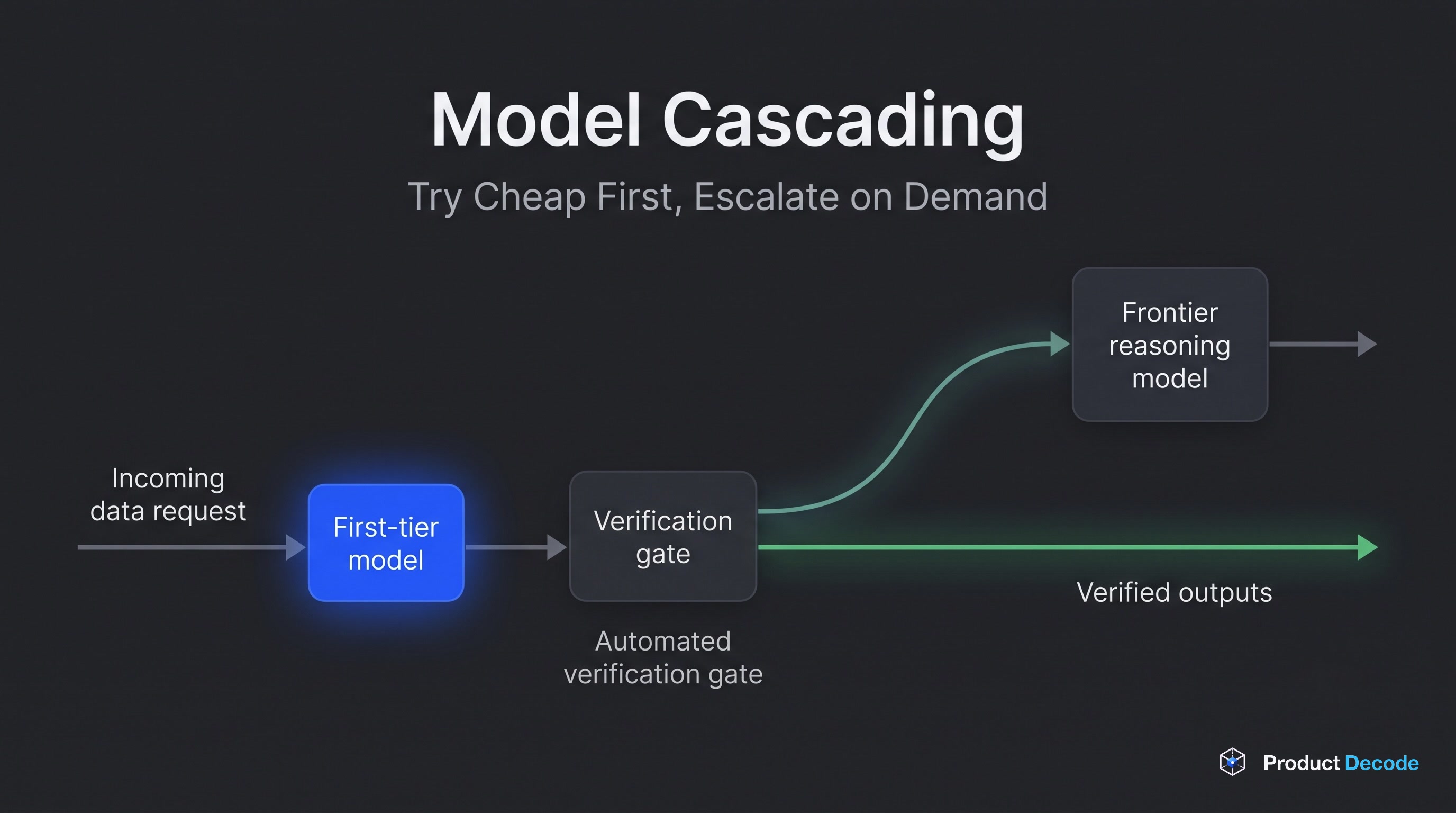
Model Cascading: Try Cheap First, Escalate on Demand
Cascading cuts LLM costs by letting a cheap model try first, escalating to a flagship model only when automated checks fail. But it carries a hidden tax: every single request pays for the first tier.
Part of: Smart Model Routing: How to Cut LLM Costs Without Sacrificing Quality
In our pillar guide on Smart Model Routing, we introduced the three primary techniques for routing requests across model tiers: classifier models, semantic clustering, and cascading. There, cascading was summarized in a single premise: send the prompt to a cheap model first, run an automated verification check on the result, keep it if it passes, and escalate to a frontier model if it fails.
On paper, this premise feels almost irresistible. You do not need to train an upfront classifier, you do not need to estimate prompt complexity before answering, and you can deploy it in an afternoon with basic control flow. But in production systems, trying cheap first is not universally cheaper. The architecture carries a fundamental hidden penalty: every incoming request pays the cost of the first tier, and if your verification boundary is poorly calibrated, cascading will inflate your cloud bill while degrading your application's responsiveness.
This article unpacks the technical architecture and unit economics behind Model Cascading: from constructing programmatic verification gates across data types, to navigating threshold sensitivity, to calculating your system's exact economic breakeven point.
Four Automated Verification Mechanisms by Output Type
The economic viability of Model Cascading hinges on a single constraint: the verification gate must be fast, reliable, and essentially free of token costs. If verifying the cheap model's answer requires significant compute or its own LLM invocation, the entire economic argument for cascading dissolves.
In real-world engineering, automated quality gates fall into four distinct categories depending on output format:
1. JSON Schema Validation (Structured Data)
This is the canonical home of Model Cascading. When an application asks an LLM to extract fields from invoices, emails, or medical records into a predefined schema (using Pydantic in Python or Zod in TypeScript), correctness can be established deterministically:
- Validating JSON parseability and syntax.
- Confirming the presence of all mandatory fields (
required keys). - Verifying strict data types (integers, booleans, ISO 8601 strings).
- Enforcing enum constraints and regex formatting patterns.
This check executes entirely in RAM on your application server in under two milliseconds, costing $0 in model tokens. If a small model (such as Claude Haiku or GPT-4o-mini) returns an output with a missing order_id or parses a monetary amount as a string, Pydantic throws a validation error instantly. The system catches the exception and immediately escalates the original prompt—along with the explicit schema failure—to a frontier reasoning model.
2. Sandbox Execution (Generated Code)
For coding assistants, internal automation scripts, or data analysis agents (generating SQL queries or Python dataframes), quality is not a matter of subjective reading—it is a binary question of execution.
Here, the verification mechanism executes the cheap model's code within an isolated sandbox container or WebAssembly runtime against an automated test harness:
- Does the syntax parse cleanly into an Abstract Syntax Tree (AST)?
- Does the script execute without throwing unhandled runtime exceptions?
- Do edge-case assertions in a unit test suite pass with expected return values?
Verification overhead is restricted to a few dozen milliseconds of internal CPU time. If code generated by a small model fails on an edge-case assertion, the runtime traceback is captured and forwarded to the frontier tier for targeted correction.
3. Heuristics & Semantic Overlap (Open Text)
Architecture becomes significantly more fragile when teams apply cascading to unconstrained prose—such as document summaries, support tickets, or editorial drafts. You cannot validate persuasive prose with Pydantic, and you cannot run unit tests on customer service empathy.
Engineering teams typically turn to heuristic scoring algorithms:
- Surface Guards: Checking min/max word counts, verifying mandatory keyword inclusion, and screening for model refusal boilerplates (
"As an AI language model..."). - Semantic Vector Similarity: Converting the candidate output into an embedding and calculating cosine distance against reference source documents to ensure the response remains grounded in context.
- Entity Retention & Fact Overlap: Running lightweight Named Entity Recognition (NER) or regex parsers to verify that key statistics, dates, and proper nouns from the source text appear in the summary.
4. Why Open Text Verification Is Inherently Fragile
The core divide is that structured outputs and code rely on deterministic verification, whereas open text relies on probabilistic approximation.
A small model can produce a beautifully structured, grammatically flawless paragraph that captures every required keyword and numerical entity, while completely reversing the causal logic between those numbers. A heuristic overlap scorer will assign that paragraph a 95% confidence score and pass it downstream. The end user becomes the unwitting quality gate who discovers the hallucination.
To avoid this failure mode, teams frequently attempt to insert an "LLM-as-a-judge" step—calling an intermediate model to review the output of the small model. But invoking an extra model to check the first model instantly destroys the unit economics of cascading, as the mathematical breakdown below demonstrates.
How Model Cascading Works in Production
Simulate the 'cheap first, escalate on failure' pattern across three real-world cases: JSON schema validation, Automated code test runner, and Threshold sensitivity.
"Extract order_id, item array, and total_cents from purchase email #VN-8821 into strictly validated JSON."
{
  "order_id": "VN-8821",
  "currency": "USD",
  "total_cents": 45000,
  "items": [{"sku": "KEY-RGB", "qty": 1}]
}100% compliant schema, strictly typed integer amounts, zero missing keys.
Nhánh không kích hoạt.
Setting the Quality Threshold: The Pareto Frontier of Cost vs. Safety
Any cascading architecture incorporating probabilistic verification requires a critical product decision: where to draw the acceptance threshold?
The threshold acts as a binary switch: outputs scoring above the line are served immediately; outputs falling below are rejected and escalated. Neither extreme is forgiving:
Strict Thresholds (e.g., Score >= 0.85)
- Product Objective: Zero defect tolerance; preventing hallucinations or omissions from reaching users.
- Economic Consequence: Escalation rates surge. Many outputs that were fully adequate for the user's intent are rejected due to mechanical metric shortfalls.
- Cost Impact: The application pays dual-tier costs on these queries—spending tokens on Tier 1, then paying full price for Tier 2. The cost savings of cascading largely vanish.
Loose Thresholds (e.g., Score >= 0.65)
- Product Objective: Maximizing cheap model retention to produce dramatic API cost reductions on monthly invoices.
- Economic Consequence: Low blended token spend.
- Product Risk: Subtle errors, unverified assumptions, and tone drift escape detection (False Passes). In low-tolerance domains such as financial reconciliation, medical triage, or compliance, the downstream remediation cost of a single leaked hallucination dwarfs months of token savings.
As explored in the AI Product Management curriculum (Lesson 14), PMs cannot treat thresholds as arbitrary engineering settings. They must be calibrated against the Task Error Tolerance: mission-critical flows demand strict gates or direct frontier routing, whereas exploratory internal tooling can tolerate loose thresholds to capture aggressive cost reductions.
Cascading vs. Pre-call Predictive Routing
Teams often conflate Model Cascading with general model routing. As described in our pillar guide, Pre-call Predictive Routing uses an upfront classifier to estimate prompt difficulty before dispatching the request to a single target model. Cascading inverts this sequence: it foregoes upfront prediction, lets the cheap model attempt the work, and evaluates the output retrospectively.
This structural difference produces opposing tradeoffs:
| Evaluation Dimension | Pre-call Predictive Routing | Model Cascading (Post-call) |
|---|---|---|
| Decision Point | Evaluates difficulty before generation | Evaluates output quality after generation |
| Upfront Complexity | Requires classifier model or semantic router | Simple code assertions or schema validators |
| Cost on Hard Tasks | Direct frontier call: Cost(Frontier) + tiny classifier fee | Dual penalty: Cost(Cheap) + Cost(Frontier) |
| Latency on Escalations | Single hop: Latency(Frontier) (~1.5s - 2.5s) | Sequential hops: Latency(Cheap) + Latency(Frontier) (~2.5s - 4.5s) |
| Routing Reliability | Bound to classifier's predictive accuracy | Bound to programmatic quality gate coverage |
The critical realization often missed in conceptual overviews: Cascading levies a "cheap model tax" across 100% of your incoming traffic. Even on an intensely complex query that an experienced engineer would immediately recognize as beyond a small model's capabilities, cascading forces the small model to fail first before escalating.
If 30% of your product's queries represent complex reasoning tasks, 30% of your users will consistently suffer double-roundtrip latency, and you will pay an unnecessary token surcharge on nearly a third of your volume.
The Economics of Cascading: Blended Cost & The Breakeven Boundary
To determine whether Model Cascading is financially viable for a given feature, product teams must calculate the true Blended Cost per Request:
Every request in a cascading system consumes the cheap model's tokens, incurs any verification compute, and bears an escalation premium proportional to the failure rate.
Blended Cost Formula & The Cascading Breakeven Boundary
Every request pays the Tier 1 'cheap model tax'. Depending on escalation rate and validation cost, cascading can slash costs by 81% or quietly degrade latency and unit economics.
From this economic ledger, three fundamental architectural laws emerge:
- The Economic Breakeven Boundary: When the escalation rate crosses 45–50%, the blended cost of cascading converges on the price of calling the frontier model directly, while doubling average user-perceived latency.
- Verification Cost Must Approach Zero: If you deploy an intermediate model (e.g., $0.006 per call) to judge a cheap model ($0.0012 per call), the evaluation fee is five times the generation cost. The evaluation overhead alone obliterates your unit margin.
- P95 Latency Is the Hidden Product Killer: Even when blended cost looks attractive (e.g., a 60% saving), if 40% of your user base experiences P95 latencies exceeding three seconds due to sequential execution, user churn will cost far more revenue than the token savings generate.
When Cascading Loses to Alternative Routing Patterns
With these constraints mapped, we can pinpoint specific production scenarios where Model Cascading consistently underperforms alternative approaches:
1. Subjective Quality & Brand Voice (Copywriting, Persuasion, Nuance)
Consider an AI sales copilot drafting personalized outreach emails to enterprise executives. The operational challenge is not grammatical correctness or structural schema—it is emotional resonance, persuasive framing, and executive brand tone.
No regex pattern or embedding distance calculation can quantify "persuasive tone." Running a small model produces generic, mechanical copy. To catch that lack of polish, you must invoke a larger model to critique the draft. The workflow degenerates into: Run small model → Run judge model to evaluate tone → Mark as inadequate → Run frontier model to rewrite. This sequence costs roughly 2.5x more than using an upfront classifier to send enterprise drafts directly to the frontier model from the start.
2. Workloads Dominated by High Reasoning Complexity
If your application handles complex legal clause reconciliation or distributed system debugging—where 70% of prompts require deep multi-step reasoning—cascading forces 70% of your requests to execute twice.
In this environment, a Classifier-based Router or Semantic Router is decisively superior: it identifies high-complexity intent upfront and routes directly to the frontier model, sparing your users the latency penalty and eliminating wasted Tier 1 spend.
3. Latency-Critical, Interactive User Interfaces
In synchronous user flows where users watch tokens stream across the screen, cascading creates an erratic, jarring experience. The UI hangs for 500ms, aborts the stream upon verification failure, and restarts from zero on the frontier model for another 2,000ms. The interface feels stuttered and fragile.
The AI PM's Qualification Checklist for Model Cascading
Before greenlighting Model Cascading for a production feature, product managers and tech leads should evaluate their workflow against four qualification questions:
- Can "good enough" be validated by deterministic code? If the answer is YES (JSON Schema, SQL parsing, AST validation, unit test assertions) at $0 token spend, cascading is a prime contender. If the answer is NO (requiring nuanced semantic judgment or human-level evaluation), disqualify cascading immediately.
- Does the cheap model achieve a baseline pass rate above 75%? Measure this against a calibrated evaluation set. If the cheap model fails more than 25% of requests in production, dual-tier token costs and latency will escalate beyond acceptable margins.
- Can the downstream user experience absorb the P95 latency penalty? Asynchronous background workers, webhook processors, and batch pipelines are ideal candidates because users are detached from the execution loop. Synchronous, stream-dependent conversational interfaces require extreme caution.
- What is the real-world cost of a False Pass? If a leaked hallucination triggers financial loss, compliance penalties, or irreversible data corruption, the downside risk is heavily asymmetric. In such cases, enforcing a hard override directly to a frontier reasoning tier remains the only responsible architectural choice.
Model Cascading is a potent unit-economics lever—provided you deploy it where programmatic rules reign supreme, and where saving tokens does not compromise the operational integrity of your product.