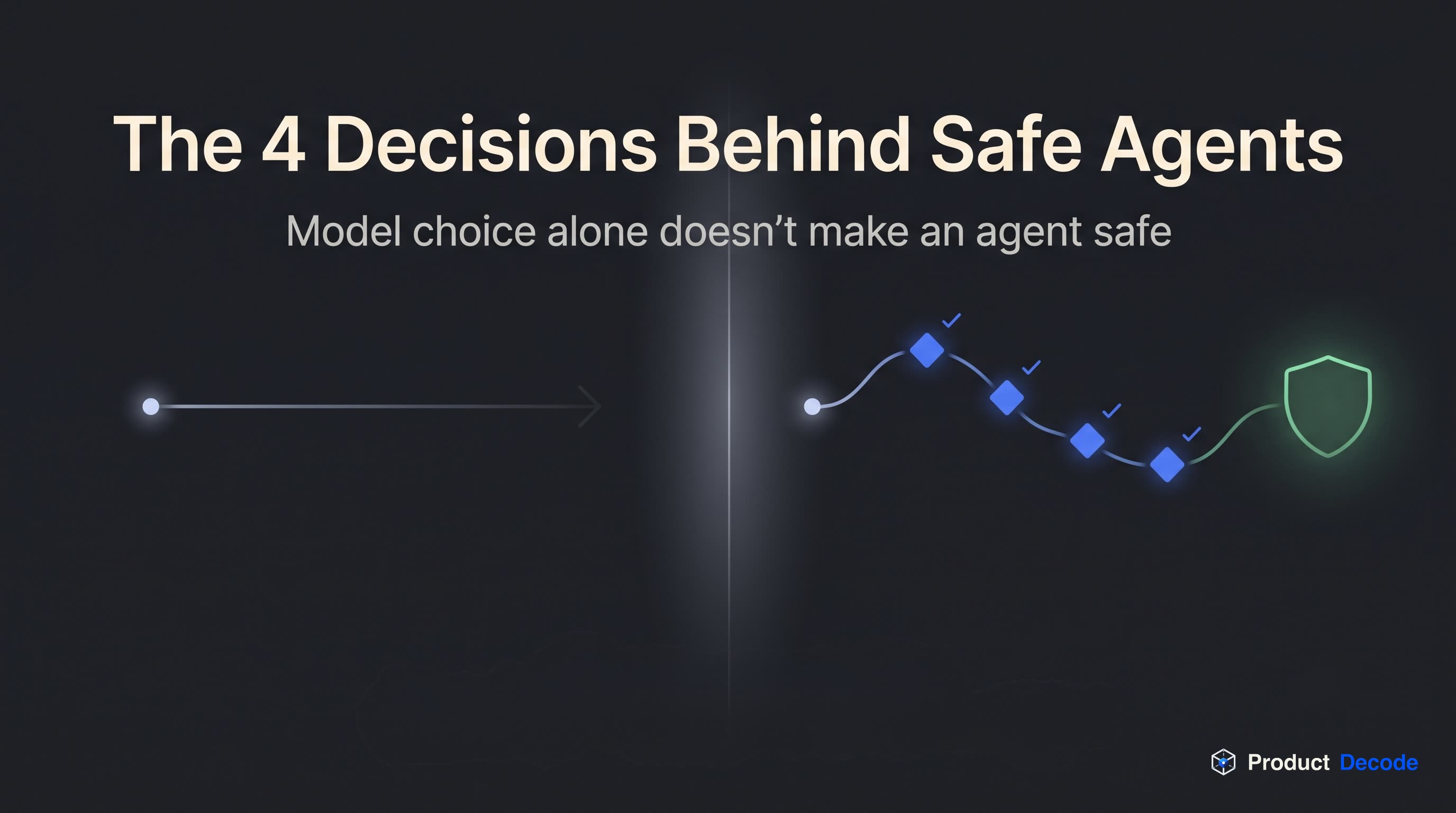
Agentic Workflow Design: The 4 Decisions That Keep an AI Agent Safe in Production
Agents don't fail because the model is weak - they fail because tool scoping, autonomy calibration, failure recovery, or agent-human handoff was left undecided. These four decisions, not the choice of model, determine whether an agent is safe to ship.
Most teams that ship an AI agent and then get burned by it didn't get burned by a bad model. They got burned by a design decision nobody made on purpose: a tool the agent didn't need but had anyway, an autonomy setting nobody revisited after launch, a multi-step chain with no plan for what happens when step two fails, or an escalation path that only existed in someone's head. The model just executed whatever gap was left open.
Agentic workflow design is the practice of closing those gaps before they turn into incidents. It comes down to four decisions, and none of them are about which model to use.
The Four Decisions, In Order
Why "Ship the Agent" Isn't a Single Decision
A chatbot that only answers questions has one failure mode: it says something wrong, and the damage stops at the words on screen. An agent that can call tools - reschedule a shipment, issue a refund, push a deploy, disburse a payment - has a second failure mode that a chatbot never faces: it can be right about what to do and still cause real damage doing it, because the action itself touches a system that doesn't roll back on its own.
That second failure mode is what agentic workflow design exists to contain. It's not one control - it's four, and they sit at different layers of the system:
- Tool scoping decides what the agent can physically reach, regardless of what it decides to do.
- Autonomy calibration decides how much of what it can reach it's allowed to act on without a human checking first.
- Failure recovery decides what happens to a multi-step chain when one link in it breaks.
- Agent-human handoff decides who ends up holding the problem when the agent genuinely can't finish it.
Skip any one of these and the other three don't compensate for it. A perfectly calibrated autonomy setting on an over-scoped tool surface still hands out root access to a system that never should have had it in the first place. A tightly scoped tool surface with no recovery plan still leaves a customer billed for a flight with no hotel to go with it.
The Four Decisions That Decide Whether an Agent Is Safe
Tool scoping is an architectural question, not a behavioral one: across every API and database the organization owns, which ones does this agent get connected to, and at what permission tier - read-only, scoped write, or nothing at all. The instinct to grant "a few extra tools, just in case" is exactly the instinct that turns a helpful agent into a liability the first time it's manipulated or simply wrong.
Autonomy calibration is the behavioral layer sitting on top of that architecture: given the tools the agent already has, how much can it do before a human has to sign off. The mistake most teams make here is treating a high accuracy score as license for high autonomy. Those are different questions - one is "can the model do this reliably," the other is "who's accountable if it doesn't" - and a workflow that lets a 99%-accurate model wire money without approval is one bad prediction away from an unrecoverable transaction.
Failure recovery is what a single-turn AI product never had to think about, because a single-turn product has nothing to roll back: hit an error, show a message, done. A multi-step agent that has already booked, charged, or published something before the failure occurs leaves behind state that a plain error message doesn't clean up. Recovery is the plan for that leftover state.
Agent-human handoff is the release valve for everything the first three decisions don't cover. No amount of scoping or calibration eliminates the case the agent genuinely can't resolve on its own - a document too corrupted to read, a request that falls outside every policy anyone anticipated. The question is whether that case reaches a human with enough context to act on it immediately, or as a support ticket that says "something went wrong."
Reversibility Is the Variable Hiding Behind All Four
Read enough production postmortems and engineering guidance on agent safety - Amazon's Well-Architected guidance for agentic systems, Google Cloud's write-ups on agent design patterns, the operating playbooks coming out of teams that run agents against real infrastructure - and the same variable keeps showing up under different names: how expensive is it to undo.
That variable is doing more work than it gets credit for. It's the reason a read-only lookup tool needs almost no scoping discipline while a delete endpoint needs to be excluded from the tool surface entirely. It's the reason an autonomy gate should ask "can this be undone cheaply" before it asks "how confident is the model." It's the reason failure recovery leans on checkpoints and compensating actions instead of blind retries - a retry on a non-reversible action just multiplies the damage instead of fixing it. And it's the reason a handoff exists at all: once an agent hits something it cannot itself undo or verify, the only responsible move is to stop and hand the decision to someone who can.
What Each Decision Bounds - and What Skipping It Costs
Reversibility, not model accuracy, is the axis that sets how strict each decision needs to be.
What It Bounds: What the agent can physically reach
Failure Mode If Skipped: A prompt injection or a bad decision can reach a destructive endpoint the task never needed
What It Bounds: How much it can do before a human checks
Failure Mode If Skipped: A confident but wrong model executes an irreversible action with nobody in the loop
What It Bounds: What happens to state after a mid-chain failure
Failure Mode If Skipped: Upstream side effects (charges, bookings, posts) are left orphaned when a later step fails
What It Bounds: Who takes over when the agent can't finish
Failure Mode If Skipped: The customer is stuck mid-workflow with a support ticket instead of a routed, contextual handoff
Each gap on its own degrades gracefully - a slightly too-wide tool surface, a slightly too-generous autonomy tier. Two or more skipped at the same time don't add up, they multiply: an over-scoped tool plus a high autonomy tier plus no recovery plan means the damage is done, irreversible, and public before a human even learns it happened.
Treated separately, the four decisions look like four different checklists owned by four different people - security reviews tool scoping, product owns autonomy, engineering owns recovery, support owns handoff. Treated through reversibility, they're one design question asked four times at four different points in the same workflow: what's the worst this step can do, and can it be undone before that matters?
What Changes Once the Agent Is Live
None of these four decisions get made once and then left alone. A model that gets meaningfully better at a task earns a case for more autonomy on it; a tool that turns out to be misused earns a case for a narrower scope; a failure mode nobody anticipated at launch earns a new branch in the recovery tree; an escalation rule that fires on every request earns a tighter trigger. Independent research tracking how much autonomous work current AI systems can reliably complete keeps finding the same pattern - task-completion horizons have been climbing steadily for years, which means a tool surface or autonomy tier configured for last year's model capability is quietly stale today, not because anyone made a mistake, but because the ground it was calibrated against moved.
That's the operational discipline underneath all four decisions: build the review cadence in from day one, because the day-one configuration is a starting point, not a final answer.
Four Pieces of a Complete Agentic Workflow Design
Each of the four decisions is a discipline worth its own deep dive:
Tool scoping. How to define a minimal tool surface, the twin failure modes of under-scoping and over-scoping, and why tool access has to be decided independently of how autonomous the agent is allowed to be.
Autonomy calibration. A concrete gate for deciding how much autonomy a specific workflow earns, and why "the model is accurate" is not the same argument as "the model should act without approval."
Failure recovery. How to architect checkpoints, retries, and compensating rollbacks so a mid-chain failure doesn't leave the system - or the customer - in a half-finished state.
Agent-human handoff. Why pausing for approval and permanently handing off to a human are different mechanisms, and what has to travel with a task for a human to pick it up without starting over.
Common Pitfalls and the Shape of a Working Design
The same mistakes show up across teams building their first agentic products: granting broad tool access "for flexibility" instead of starting from zero and adding only what a task requires; setting an autonomy level once at launch and never revisiting it as the model, the traffic, or the risk profile changes; treating a retry as a universal fix instead of checking whether the failed step was even safe to repeat; and building an escalation path as an afterthought, discovered only during the first real incident when a customer is already stuck mid-workflow with nobody to route them to.
Strip away the specifics of any one product, and a working agentic workflow design does the same four things well: it draws the tool boundary before deciding how the agent should behave inside it, it earns autonomy through reversibility rather than raw accuracy, it assumes a multi-step chain will fail somewhere and plans the cleanup in advance, and it gives every failure mode the agent can't resolve on its own a clear, well-informed path to a human. Get those four right, and the model choice underneath them stops being the thing standing between a helpful agent and a costly one.